Son
In the confined space of Ward 8’s corridor, the doctor motioned me to come closer. I looked down at her name badge, and then up again at her kind, reasoning eyes.
“We still have to speak to his kidney team, but we think your dad’s going to need an MRI to determine what the lesion is.”
Dad was in Bay J, behind Dr Barlow. The door was ajar; the windows Dad stared at were greasy with condensation. He’d been trollied there after one too many incidents in Bay A, confronting men younger than him, using a walking frame to threaten them. In my eyeline, Dad was lifting his bedsheet. He was patting it and folding it. Over and over.
“You might need your dad to have the MRI,” Dr Barlow continued. “Seeing that the lesion is growing on the kidney you donated.”
“I’m not sure I follow,” I said.
“Well, there might be something we need to learn about why the lesions there. You might want to know.” A bell rang unanswered.
Dad’s care home had phoned 999 because he’d been experiencing delirium. His symptoms of dementia were worsening. It was the lesion they’d seen in one of their scans that I couldn’t stop ruminating about. Another doctor had scribbled down on paper that it was “suspicious”.
The first few days of Dad’s stay, I scoured a digital platform from a distance. I read the hospital’s reports, like I’d read Dad’s previous reports, written by neurologists and nephrologists. There were reports of ‘Cerebellarvolume loss’: that was one of the things he was suffering from. There were damaged nerve cells that I couldn’t picture. Then I saw the report that his ‘native’ kidneys had ‘atrophied’. That was a crisper image. It transported me to our smoked salmon and bagel brunches on Shabbat, and the pickled gherkins Dad kept for weeks, shrivelled in jars of murky green water.
Again, Dr Barlow’s voice. Perhaps I too would be at risk, one day, of kidney disease, or some other inherited malady. This hardly came as news, and this wasn’t quite where the Doctor was headed. Where there were gaps in the Doctor’s account, my mind quickly filled them. Mum had passed away of kidney cancer, and there was Dad, with some kind of growth on his left kidney — well, my kidney. I peered over Dr Barlow’s shoulder. It would be too simplistic to characterise what I felt as sadness. As I entered Dad’s room, I have to admit to also feeling self-pity, and something like resignation.
—
Me
“When you were a child did you breathe and make a face like this?” the Otolaryngologist asked me. She harrumphed like a grunting piglet. Sitting across from her in her white coat, I took in the confusing scene.
I wasn’t the mouth breather she was mimicking, but I knew exactly what she was inferring. Doctor Vadura spun around her computer monitor to show me images of “Adenoid children”. Her face was contorted.
“No, I wasn’t like that.”
It’s true that my nose grew in shape when I was an adolescent. At thirteen, I was gangly, hunched over, and my nose protruded from my angular face. Still, I didn’t appreciate being shown photos of droopy infants.
“As your nose is so extreme, taking your CT scans, the way to operate on you isn’t just a septoplasty, you need a rhino septoplasty. We’ll be fixing you for functional reasons, but there will be an aesthetic change.”
Streaking down the windows of Doctor Vadura’s minimalist consulting room, rainfall seemed to underline something rather final.
It was the word “extreme” that hit me. I always thought my nose to be extreme, but here was this clinician punching me in the face with something seemingly objective. Something about my face was causing me medical problems.
Surgery it was to be then. For my sleep apnoea, and the deviated septum that a few months later, a new Doctor, Dr Chantre, in another hospital, said was “one of the worst” he’d ever seen. By then, the leaves were a mix of opal colours, brimming yellow, gold and green. Newly settled in Lisbon, looking to try family life in Portugal, I had to think through the options for an operation.
Say I didn’t proceed? I asked this. “What is the worst thing that could happen?” Dr Chantre didn’t answer my question using the conditional tense.
“In the long-term? Well, the research is telling us severe sleep apnoea leads to cardiac issues, vascular issues. Dementia.”
*
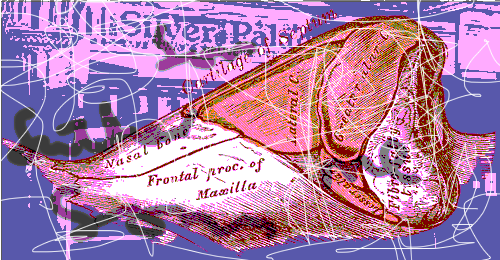
My nose was always the first part of me a stranger would see. I made sure I always walked into the school refectory face forward. ‘Don’t show them my side profile.’ That’s how I used to talk to myself as a teen. The mountainous bone of my nose ran ahead, like Gogol’s nose in the Russian play. Unruly. Wayward.
Sitting on the tram back home from my appointment with Dr Chantre, Halloween ghouls and masks dangled from streetside kiosks and awnings. Looking towards Lisbon’s hills, I touched the bridge of my nose, then slid my fingers down the slope. I still do this, thirty years later. Hide it. Seek to diminish it. I’ve done this since the age of my Barmitzvah, which is no coincidence. Best to hide my most conspicuous Semitic feature.
For how long might I still repeat this action? If Dr Chantre were to break the bone, would I trace the ghostly outline where memory of the bone still lingers? In its stead, will I enjoy the silky touch of a smooth nasal root, and, alien to me, an Aryan dorsum?
Will all the other ills, real or imagined, heal or cease to preoccupy me? Will the removed, or re-shaped, cartilage change the way I see my other body parts, as friends and not things destined to fail me? My uvula needs shortening in length. So says Dr Chantre. If I were to agree to this, would I breathe better at night? Sleep better? Would I cope better as a dad in the daylight hours? Will I feel new vigour? If I were to titrate, and at last, quit my antidepressants would I give our boys, and especially Noam, the energy and attention he needs? Might I switch tracks and journey to a different health destination?
Like me, Dad was a bad snorer. Now we’re being asked to consent to his nurses mashing up his pills and serving them in his food as powder.
How miraculous can this one operation be? I’m told to view it as an act of preventative medicine. I know I don’t want one of our sons undergoing the same checks I did for Dad, being asked to donate one of their kidneys to me, having to tail doctors in draughty hospital corridors.
In 2045, Noam and I might still find ourselves sitting across from each other in a Chinese restaurant, like Dad and I did in Vauxhall one night, when he summoned the courage to ask me for an organ.
Andrew, sixty-three years old, “You really don’t have anything to worry about, truly. I’ll be fine.”
Noam, then twenty, “I still want to do the test. For me, I mean. I still have a pre-disposition to kidney disease. So it’s best I already look for a donor, add myself to the register.”
Why undergo five hours of surgery to reconstitute my face, still sure in the knowledge that transmitted to me, also in my blood and flowing as toxins, are hypochondria and disquiet? I’m certain to have passed this on, and if it’s modifiable, if I can epigenetically change anything for Noam, my genetic son, now is the time to omit less stress, when he remains an infant.
There’s an odd part of me, though, that knows a strange comfort feeling tethered to my restless Ashkenazi Jewish family. There’s a part of me that only comprehends uncertainty, catastrophising what might go wrong, a part that takes queer pride in our ancestral story of voyaging across lands, stalked, inevitably it seemed, by illness. In chopping off my nose wouldn’t I be committing an act of denial, choosing my own path of disinheritance?
—
Father
March 2025, when this current journey towards having an operation begins. It has been raining for days. Noam’s face is lit with a rich lilac colour. He lies propped by a fancy cushion, tilted in his cot. Next to him, the sound machines I purchased from El Corte Inglés. They whirr and purr, like bedside monitors, but we’re not in a paediatrics ward. I’ve only just bought the second of these devices, to coax Noam into a productive state of sleep.
I use the lava lamped glare of the dreammachine to measure whether Noam has managed to feed. Against the device’s battery-fading chorus of Johann Strauss’s waltz, I slope the bottle higher still, to check — but Noam has barely swallowed any milk. I can see clearly now, as the dreammachine illuminates Noam’s shutting eyelids, one moment a purple lick of skin. Next a lagoon teal, both dreamy and sickly.
I’m catatonic here and so the colour purple takes me to other scenes, places I remember feeling vital; to the Colombian guys I used to love being with, their nipples before me like rosary beads.
I look in the mirror. Remember what the chiropractor explained to my husband and I, that Noam’s mandibular was problematic, and if he was anything like me, his biological Dad, Noam would “struggle with nose breathing”: with breathing full stop. I understand variably that Noam has “mechanical problems” and that these are “internal”. Even now, they predicted he’d experience later life sleep apnoea. Would he be worn down by his nose? Would his penny round face lengthen and narrow and freakishly elongate to become a version of Edvard Munch’s scream?
The longer we left him afflicted, the risk was, he could become more like me. That was always my worry, wasn’t it? Not with Ismaël, our firstborn, but in agreeing to a second son. The one my husband and I decided would be mine, fertilized by one of my sperm specimens, one of the four male embryos my specimens had created, frozen through mezzanine fertility treatments. He would be Andrew Kaye’s son, and Leon Kaye’s grandson, and how unlucky might that turn out to be?
—
Me
I hadn’t
realised it possible
that I might grow into kinder
ownership of my own looks
transplant, Andrew McMillan
I did, though. Grow into kinder ownership of my own looks. I rejected the offer of rhinoplasty aged eighteen, when my father took me to see a celebrated plastic surgeon. Dad didn’t disabuse me of the notion that I had a big nose and offered to pay for a smaller one, “if that’s what I wanted.” Mum was no longer alive to object, as she would have.
At 23 Harley Street, rhinoplasty was advertised as a rescue mission for those whose noses attracted negative attention. The surgeon traced the lines where my jawbone contracts and my chin subsides. He drew a red marker pen over the contours of my face. He suggested further surgery to my cheekbones would deliver a more effective result than a simple operation to break my nose, and in so doing, he overreached. I was taken back to history lessons and the Nazis’ racial determination tests measuring people’s skulls, the size of their nose, examinations that, had I been a thirteen or forty three year old in 1930s Dusseldorf or Cologne, I was sure, would have seen me “fail”.
When I flirted with the idea of an overnight stay in a Harley Street hospital Dad was doing well at work, and at the time I felt grateful for how unfussy he was, unrestrained in generously offering to pay for reconstructive surgery. It was only later that I reflected that he seemed too uncritical of my decision, too eager, perhaps, to see his son change his face. I never once heard him criticize his own nose, but it wasn’t so different from mine. As an adolescent, the standard refrain I heard from him when he discussed me with relatives was that Andrew would “grow into his face”. Could he be sure, or was that what he was hoping to see? Was he, too, keen that we should all appear that little less conspicuous?
When I did well at school and got to university, he was proud of me. He said this many times over. I am proud to be Noam’s father. What I’m keen on though, is to admit – at least to myself – where as a son and a father, I’ve nursed reservations, and how I continue to chew over the ambiguities in our relations.
—
Son
A woman groaned from one of the nearby bays. I continued to punch away on EasyJet’s app, but it kept on freezing on the section asking from which airport I’d be travelling. Was I really meant to return quite this quickly to Lisbon? This soon, to ferry Noam around, whilst Dad was still experiencing discomfort? I was in a makeshift space to the back of Ward 8, avoiding Dad, running through how the afternoon might unfold: the ways I’d need to slow down my breathing when Dad started getting agitated and his illness started shouting at me.
In the distance, the silvery River Thames. At that bend in Fulham, close to where Dad last lived before my sister and I took him to live in a care home, I had also felt defeated, walking on windy evenings after failing to get Dad to – this was my impression – see reason. To quit driving after his eyesight failed. To respond to the many letters dropping on his doorstep.
Sitting in a stiff-backed chair, only stacked tables around the edges of the visitors’ room to accompany me, I felt a tougher tug than usual, a resistance to seeing Dad so thin, so visibly angry with me. People always say, ‘oh, that’s the illness,’ but what they don’t realize is that Dad always had a fear of being institutionalized like this, the fear sown when he visited his straitjacketed father at London Colney mental hospital, one of the old Victorian asylums. He always did say he’d prefer a pillow over his face than to suffer the same fate as my grandfather, Arthur.
Nurses who recognised me from earlier visits smiled at me quizzically as they passed by. ‘Why wasn’t I relieving the healthcare assistant supervising Dad of their duties, back in Bay J, preventing Dad from once more climbing over his bed rails?’ That’s the question I observed in their eyes. ‘Why wasn’t I helping Dad to take his beaker of water, or placing it like a good son by his lips?’
My legs took me to his bedside. Dad’s wrists and forearms were swollen the colour of lavender. When he settled, possibly thanks to the Lorazepam, I noticed he still slept with his mouth wide open. His floor was strewn with torn off squares of toilet paper. I crouched down to clean them. Next, I kissed his forehead, like I did that day of my second visit, when I called him a ‘good man’, and a ‘good father’. He smiled that day, stood a bit more upright, turned ever so slightly towards me. That day, he looked at me like a wrong had been corrected.
__
Sons
What happens when a sense of familial connection feels forced? Or worse, when it feels like it confines us? In the slip where a father (or a son) admits to those feelings, shame disables us. I’d like to hear those of us sandwiched between ageing parents and very young kids say something about our mixed feelings. We ought to commune in this idea that balancing kinship ties is one of many dilemmas we’re bound, some of us, to experience.
I’ve read gentle accounts of new fatherhood, and harrowing memoirs of ruptured relationships, but little about the intestinal impatience that tugs inside of uncertain fathers, ticks inside of me, at least. ‘Fuck me, why can’t he just sleep?’ I’ve muttered this, about both Dad, and, next to his cot, about Noam. Which conceals a deeper feeling.
I’ve possibly been my most useful self, or so I convinced myself of this, fastened to Dad, trying in some futile way to intervene and rescue him. We were a team, getting from his diagnosis to his divorce, all the while hatching plans to pay off his debts. What new love could my heart embrace as his exhausted son, as someone in recovery from co-dependence?
I was possibly my happiest self as Dad’s kid, but those feelings are harder to access. Now all those feelings have withered – I’ve had to let them grow distant – and I no longer feel I possess the reserves of patience I need, not just to be the archetypal ‘dutiful son’, but also to be a ‘doting’ or even a half-decent father.
There are times when Noam smiles and I smile back, and I’m aware of my cheekbones. There’s a stretch of a feeling. Nothing about my facial expression feels natural. So I look even more intently, into Noam’s speckled blue-grey eyes and try to observe in him, in his reflected stare, something I might accept. Not about him as such, but about myself. That I’m worthy of being his father. That through what he gets to inherit from me, I can take some measurement of relief, some pride for instance.
I can write all this from a vantage point that as a new Dad, I haven’t cracked anything, but I took Noam out a bit more in the pram. Just last week, I took him to Mercado do Ajuda. He laughed when I let my eyes dance and made funny faces. It was just the two of us. I enjoyed this. So did he. We played a form of peek-a-boo. Not performatively, not with others’ watching. What do I love most about his face? His round cheeks: our egg donor’s.
Sometime in the spring of 2025, Noam had his tongue tie operated on. Feeding him became easier. In his inquiring face I came to see something of my sister, or possibly our Mum. Whatever I’ve hated over the years about my Semitic nose, and the ways in which I came to view it as an unpleasant inheritance, I soon came to see Noam won’t inherit this nose, not now the doctors claim to have sorted his nose breathing.
Around the same week, Dad’s calls to me started trailing off. In place of this, I was investing all my time and attention in Ismaël, our firstborn: our son, but my husband’s offspring. His face didn’t remind me of my failings or my heritage. I could bear to look at him, because through him I figured I could be a success. If I was to pass anything on, it might be my values and my education, but not my body, not a physical likeness.
There’s always a postscript, though, and only last night I saw a glimpse. I felt the very best I’ve felt so far as Noam’s Dad. He fell to sleep as I gently circled my fingers on the crown of his head. ‘I’m responsible’, I thought. In that, there can be no ambivalence.
Then, as Noam was lying with his face to one side on our bed, I could hear such loud and punctured breathing. Effortful. His chest looked to be doing heavy work as his heart beat. It made me wonder once more. What’s the size now of Dad’s lesion?
Andrew Kaye Kauffmann
Andrew Kaye Kauffmann is a coach and a tutor of therapeutic writing. The Centre for Mental Health’s 2024 Writer in Residence, he delivers writing for wellbeing workshops for members of brainstrust, a UK based brain tumour charity. Elsewhere, he’s led workshops on writing challenging material for London Lit Lab, Carers UK, Renal Arts Group, The Literary Consultancy and The Write Salon. A coach who focuses on stories as a tool to support individuals undergoing life transitions, Andrew is undertaking an MA in Creative Writing and Wellbeing at Teesside University.