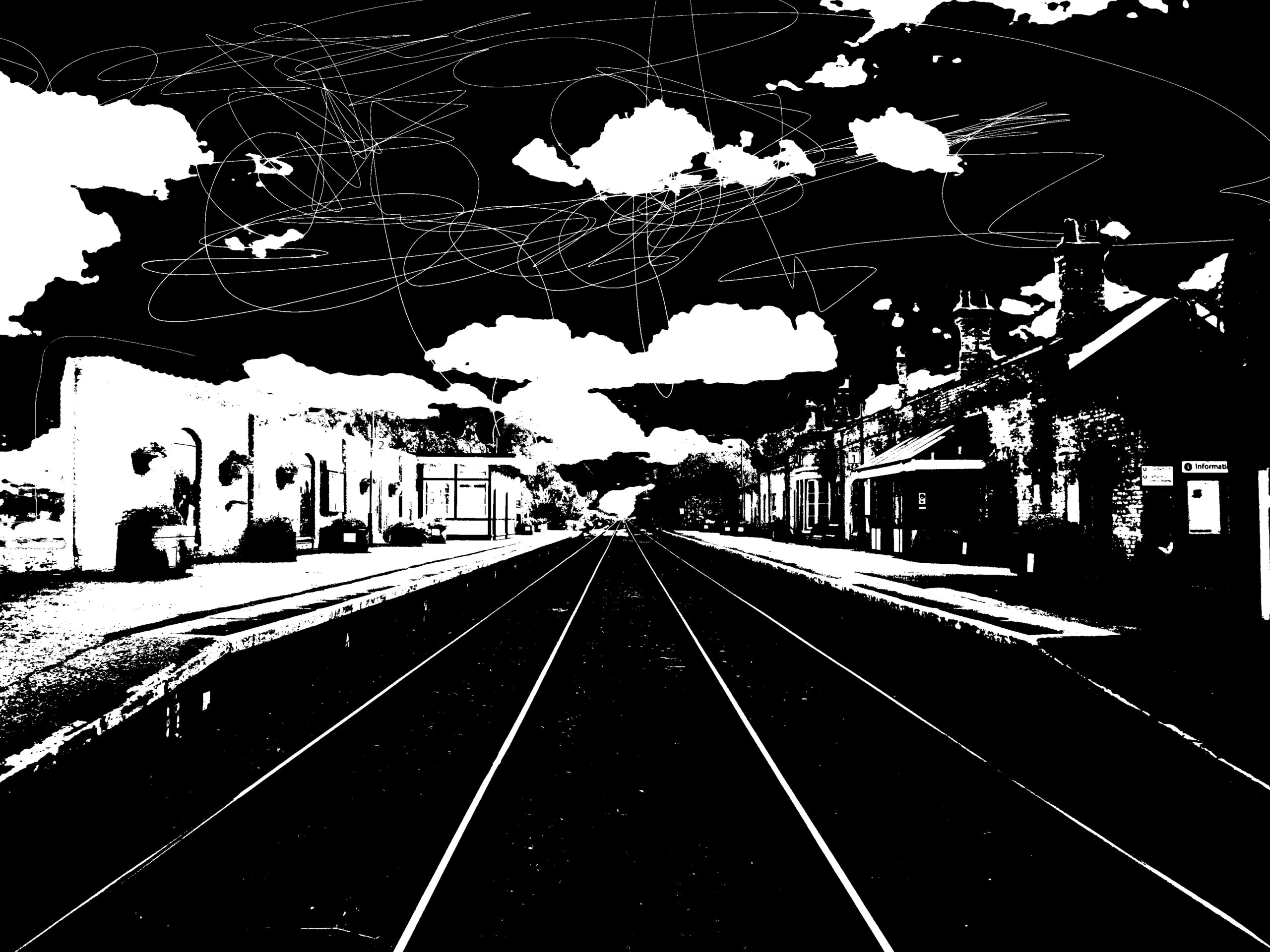
THE LONDON EXPRESS
He must be six then, maybe seven – still
young enough for shorts, because that’s
what they ought to wear at that age. And not
old enough to defy his mother, his fringe
showing the toothmarks of my kitchen scissors.
Trapped by my shutterclick: a yellowing photo
one from our first camera. He stares at the wristwatch
he unwrapped that morning, too naïve yet to notice
the irony of its timeless design. He still wants time
to travel faster, the days to be shorter, each week
as yet a measurable fraction of everything that
he has come to know so far.
Look how much he yearns to be like his father:
to catch daily trains at 7.15, to travel the same miles
over and over. To escape the long, interminable
days of the primary school years. In forty years,
he will beg to be that child again, for days
that last forever. Days that don’t pass as fast
as the London express, hurtling nowhere special
again and again and again.
A FINAL BED
As much as he ever spoke of feelings,
he would surely say that he liked it here.
A climbing rose holds a crumbling stone wall
in a tight embrace, a musk-scented specimen
chosen for the softness of its thorns, for
its ironic resilience to cankers and blight.
We have tucked him under a counterpane
of English civility, of delphiniums and daisies.
It’s beautiful, of course – correctly serene for resting
in peace: only in close-up serenely incorrect.
A Garden of Remembrance, the gate declares,
but so many memories omitted. We are far
too far from a village green crease and wicket,
the lulling thwack of willow and leather. From
the chink of beer glasses on a wobbling tray
and the slo-mo ballet of his umpire’s finger,
passing wordless judgement on poor form
or bad play. A pretty tapestry, but too few threads
to weave the proper picture: no silver-screen
cowboys will pass this way on tired horses, riding
off into the ever-after of a Panavision sunset.
No ticket stubs from cinema matinees, no old photos
of the bowls team or the air force squadron lads.
Nor the crashed jeep and the indignant elephant
on a night-time road, high on an Indian mountain.
Those unruly memories pruned away as kind-heartedly
as the gardener’s secateurs discreetly trimming away
his straying branches. History tidied to a seemly still life.
PROTEST
Marcher #927,453: goatee beard,
one gold earring: still rolling his own,
we see. This year’s most popular Banksy
t-shirt, flat feet in the canvas sneakers
of someone as young as he would
like to still be. Feet that will walk
once more from Embankment to Hyde Park,
retrace the steps of a hundred protests,
a thousand virtuous long-lost causes.
The banners and chants might vary – or
not – but the song remains the same. Determinedly
individual, just like #384,129, just like #106.
No fancy camera technology necessary
to build profiles, trace patterns, write files
to secret servers. Behind our riot shields
and our telephoto lenses, we can almost
admire his endless plodding tenacity – ignore
our own symmetry of uniforms and helmets,
of shaven chins behind tinted visors.
A thousand selves, as guarded as the doors
that we stand here to protect, arm in arm:
a paper doll chain of impenetrable black.
Dave Wakely
Dave Wakely’s writing has been shortlisted for the Manchester Fiction, Cambridge and Bath Short Story awards, and his poetry has appeared in journals and anthologies, including The Alchemy Spoon, Impossible Archetype, Lighthouse and Poem Alone. He lives in Buckinghamshire with his husband.